Resources
![[Tori] Goldcast Insider Emailers](https://cureis.com/wp-content/uploads/2025/10/HR1_Resource-Center_Website_Column_Ad-1024x576.jpg)
Author

Before You Buy Another AI Tool. Five Readiness Questions to Ask.
The Data Readiness Audit Your AI Vendor Won’t Suggest
The Demo That Sold You, and the Monday Morning That Didn’t
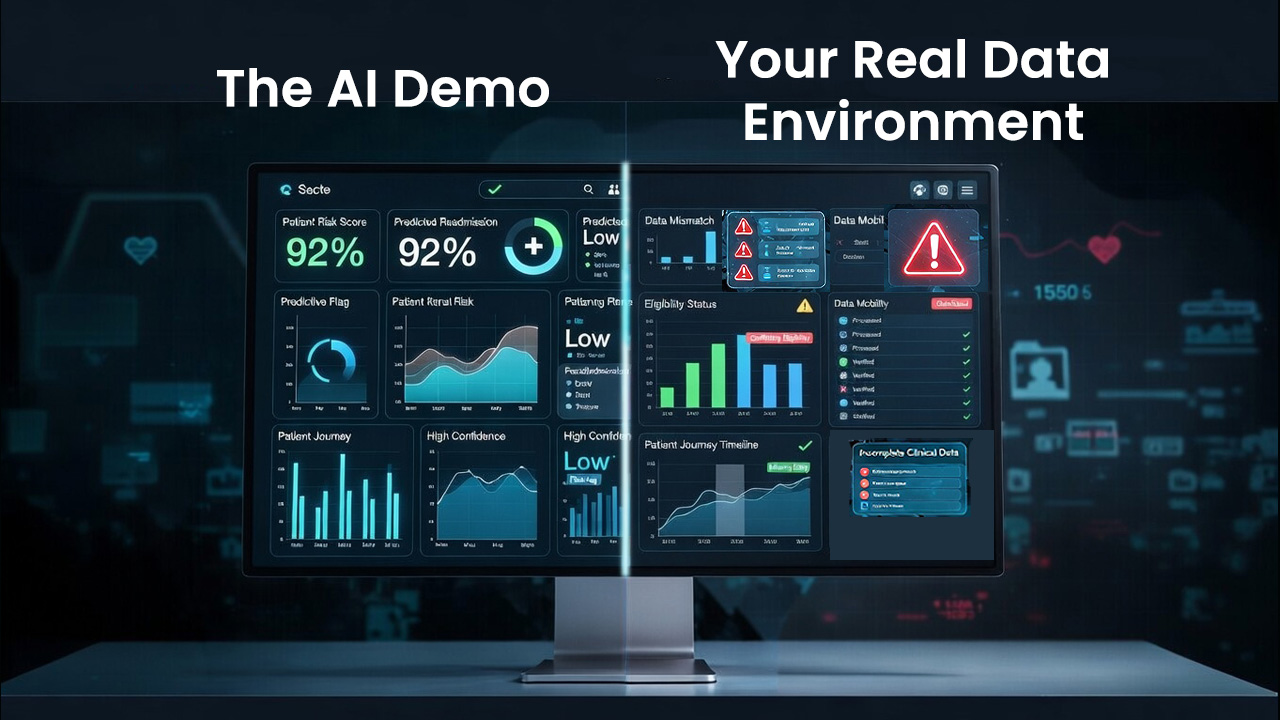
The demo was flawless. Crisp dashboards. Instant risk flags. A predictive model that surfaced exactly the right patients at exactly the right moment. The sales engineer smiled like he’d just cured cancer. Your CFO was nodding. Your team was leaning in.
A redline session later, the contract was signed.
Then came Monday morning. In the real world.
The risk flags were confident, and completely wrong. Eligibility data contradicted itself across three systems. Enrollment records from last week clashed with this morning’s updates. The model, trained on pristine demo data, had no idea which version of reality to trust. The dashboards lit up all right, mostly with error alerts.
Welcome to what Gartner calls the “trough of disillusionment” – the lived experience of seven out of ten hospital and health plan leaders currently reporting what happened when their new AI pilot met actual healthcare data.
And the vendor whose demo sold you – did they offer to run a rigorous data readiness audit before you signed their contract? Did they urge you to run one, in-house?
Your Vendor Knows the Risks. They’re Selling You the Tool Anyway.
Here’s the part of the healthcare AI conversation that rarely makes the keynote stage: vendor demos and your production environment have almost nothing in common.
AI vendors know that. Their tools are trained and showcased on clean, curated, internally consistent datasets. It’s the healthcare equivalent of a Hollywood set.
Your data, by contrast, arrives messy, fragmented, stale, and contradictory from numerous sources. The same patient can look like three different people depending on which system you ask. Eligibility files don’t align. Clinical notes arrive incomplete. And unless you’ve already built robust conformance and conflict-resolution rules, there’s no single source of truth for the algorithm to trust.
No one is saying AI tools are bad. There are sophisticated, well-engineered solutions in healthcare that would deliver exactly what they promise, if only the data underneath were sound.
The problem isn’t that good tools don’t exist. It’s that the AI gold rush has inspired a wave of immature products, and the market can’t always tell the difference between a tool that’s battle-tested and one that was rushed to market with a flimsy understanding of healthcare data challenges. The outcomes are subpar, either way. Mature tools get undermined by the same dirty data that the immature tools never accounted for in the first place.
85% of healthcare organizations have explored AI, yet only 18% feel truly ready to deploy it at scale. That’s a 67-point gap between excitement and infrastructure, and someone is cheerfully selling tools into that gap.
Five Questions Your AI Vendor Won’t Ask, But Your Data Team Should
Before the next demo hits your calendar, take these five questions to your own data team. The answers will reveal more about your AI readiness than any product showcase ever could.
- Can we produce one clean, consistent patient record across all our systems in under 60 seconds? Not a record pulled from a single EHR or claims system – a reconciled, real-time version of truth that reflects what every system currently knows about that patient. If the honest answer involves manual lookups, cross-department phone calls, or “it depends which system you check,” then you already know what your new AI tool will inherit: the same conflicting answers your analysts wrestle with every day, only now delivered at machine speed.
- What percentage of our analyst time is spent fixing data rather than using it? Industry benchmarks put this number between 60% and 80% for organizations without a conformed data layer. If the majority of your team’s week disappears into reconciling spreadsheets and chasing discrepancies, that’s not a staffing issue, it’s an infrastructure issue. No downstream AI tool can fix what lives upstream.
- When two systems disagree on the same data element, which one wins — and does everyone actually know the rule? Tuesday’s eligibility file says terminated. Thursday’s enrollment record says active. Which is correct? If the answer is: “it depends” or “whoever catches it first,” you don’t have a data quality problem; you have a conflict-resolution vacuum. Every AI model will simply make its own best guess. Different models, different guesses. Zero trust in the output.
- How current is the data our AI will actually consume? A model making real-time decisions on data that updates weekly isn’t operating in reality – it’s operating on a memory of reality. Ask your team: what’s the actual latency between a change in the source system and when that change becomes available to our AI tools? Days? Then your AI isn’t predictive. It’s retrospective with extra confidence.
- If a regulator asked us to prove exactly what data informed a specific AI decision last Tuesday, could we? This question is no longer theoretical. HIPAA’s evolving security rules, emerging AI transparency requirements, and tightening CMS oversight are converging on one clear expectation: full auditability. What your system knew, when it knew it – and how that data shaped that AI decision – is fast becoming table stakes. If your infrastructure can’t answer this today, your governance gap is about to become a compliance problem.
The Real Readiness Audit
If those five questions made you squirm a little, good. They’re meant to surface the uncomfortable gap between the boardroom narrative (“We’re doing AI!”) and the data-team reality (“We’re still reconciling last week’s spreadsheets”).
The HealthEdge 2026 Healthcare Payer Survey quotes: 31% of executives believe their organizations have achieved widespread AI adoption. Only 3% of operational leaders agree. That 10-to-1 perception gap is one of the most under-discussed dynamics in healthcare AI right now. The C-suite sees the demo. The operational teams live with the data.
The organizations actually seeing ROI aren’t necessarily the ones with the flashiest tools. They’re the ones that did the unglamorous infrastructure work first.
What “Ready” Actually Looks Like
It looks… boring. That’s the point.
It looks like a data layer that quietly reconciles conflicting records before any AI model ever touches them. Where an eligibility discrepancy gets resolved by documented rule hierarchies, not by an analyst burning hours on the phone. Where the data feeding your AI tools is current, conformed, auditable, and trustworthy by default.
This is what we built UniSync™ to deliver: not another AI tool competing for shelf space in your stack, but the neutral “data refinery” that makes every AI tool on your stack actually work.
UniSync™ ingests from your existing sources, applies healthcare-native conflict resolution and conformance logic, and delivers a single, real-time, certified layer of truth. It turns Question 1 into a confident “yes.” It reclaims the 60–80% of analyst time lost to manual fixes. And it gives you documented lineage so that when the regulator asks what informed last Tuesday’s AI decision, you can answer in minutes, not weeks.
Best of all? It sits alongside your current systems. No rip-and-replace. No 18-month death march. Enterprise-grade data management that pays for itself faster than most people expect.
The Best AI Investment You Make This Year Might Not Be a Tool
Healthcare organizations are projected to spend more than $1.4 billion on AI this year. When it works, the average return is roughly $3.20 for every dollar invested. But when over 80% of pilots never reach that return, the majority of that spend is at risk — not because the technology is flawed, but because the foundation underneath it was never properly audited.
Before you sign the next vendor contract, have the honest conversation your sales engineer is hoping you’ll skip. Five questions. Your own data team. No PowerPoint. No demo.
The tools are getting smarter all the time. The real question is when your data will catch up.
About CureIS
CureIS Healthcare has spent more than two decades helping managed care organizations and health systems close the data quality gap. Our UniSync™ Healthcare Data Management Platform was purpose-built as the neutral data refinery that turns fragmented healthcare data into the trustworthy foundation AI needs. Our data centers are SOC 2 Type II attested. HIPAA compliant.
Related Posts
Before Claims AI, Build the Record an Auditor Would Trust In Brief: Mid-market...
An audit will require a record, not a reconstruction. In Brief: Arizona did...

In Brief: An auditor’s first question about a claims AI decision is usually: why...
