Resources
![[Tori] Goldcast Insider Emailers](https://cureis.com/wp-content/uploads/2025/10/HR1_Resource-Center_Website_Column_Ad-1024x576.jpg)
Author

The Data Trust Score: Why Connected and Conformed Isn’t Enough
Autonomous AI Agents are Exposing the Healthcare Data Confidence Gap
As healthcare organizations race to operationalize agentic AI, traditional data governance and quality efforts fall short. CureIS’s Data Trust Score – a production-proven, dynamic metric embedded in the company’s UniSync™ platform – quantifies trustworthiness at the individual data-element level, enabling confident, auditable automation and agentic AI success in the operational realities of the health data ecosystem.
Your data is clean. It’s governed. It’s normalized to every industry standard. But when an AI agent reaches for a member eligibility record to adjudicate a claim in real time, that “flawless” record turns out to be 72 hours old. A fresher file is still reconciling. The plan sponsor just issued a retroactive correction. The AI hesitates – or worse, it acts with unearned certainty. That single moment exposes the trust gap that governance frameworks and traditional data-quality projects were not built to close.
However, connected, conformed data is no longer enough. As AI moves from pilots to core operations across claims, eligibility, payment integrity, and retroactive change management, every AI agent, every automated workflow, every real-time decision engine now needs to answer a question most data architectures were not designed to address: How much should I trust this specific piece of data, right now, for this specific purpose?
That question demands something the industry doesn’t yet have in production: a Data Trust Score.
A Trust Gap Is What Lenders Faced Before the FICO Score
The healthcare IT industry talks constantly about trust—in governance frameworks, compliance processes, clinician-patient relationships, and now AI models. Yet almost no one has asked the foundational question: Can we measure and continuously elevate the trustworthiness of the data itself?
This is the same inflection point the financial sector faced in 1989. Before the FICO score, lenders relied on static checks and gut feel. FICO introduced a dynamic, multi-factor metric that enabled confident, scaled decisions at speed. The CureIS Data Trust Score does the same for operational healthcare data.
Unlike theoretical “Data Trust Indexes” proposed in academic preprints and tested primarily on synthetic or narrowly curated research datasets, our Data Trust Score is battle-tested daily in live, high-stakes managed care environments. It scores millions of real-world records across government programs and commercial operations—where eligibility files arrive stale, plan sponsors issue retroactive corrections, and agentic systems must decide in real time.
What the Healthcare Data Trust Score Actually Measures
At CureIS, trustworthiness is not a binary clean/dirty flag but a composite, contextual, continuously computed property of each data element. Our proprietary Data Trust Score, deeply embedded in the UniSync™ Health Data Management Platform, evaluates five production-proven dimensions:
- Freshness. How recently was this record confirmed by its authoritative source? A member eligibility snapshot verified five minutes ago carries exponentially more weight than one verified five days ago—especially during open enrollment.
- Lineage Integrity. Can the system trace every transformation with full bitemporal versioning—knowing both what the system knew and when it knew it? Essential in an environment of constant retroactive corrections.
- Reconciliation Confidence. When multiple sources conflict, how definitively was the golden record resolved? Harmony across three payers scores far higher than rules-engine arbitration between two contradictory files.
- Contextual Completeness. Does the record carry every attribute required for this transaction? Eligibility sufficient for a quick coverage check can be dangerously incomplete for complex adjudication or risk adjustment.
- Volatility Awareness. How frequently and predictably does this data change? Low-volatility provider NPI data demands different weighting than high-volatility plan assignments.
None of these dimensions is new in isolation. What UniSync delivers is their unification into a single, real-time score that travels with every record and directly guides automation.
Why Data Trust Scoring Is an Urgent Priority Now
Teaching someone to swim is more effective than performing CPR after they drown. When human analysts notice a data anomaly, they instinctively apply context and judgment. Agentic systems lack that instinct. Without a structured trust signal at the data layer, they operate with certainty they haven’t earned, scaling errors at machine speed: mispaid claims, compliance exposure, revenue leakage, and eroded stakeholder confidence.
This is the decisive battlefield in the payer-provider AI arms race. Providers weaponize AI for “perfect” claims. Payers build defensive adjudication engines. Both sides are learning that model confidence is only one axis. Data confidence is the other—and the one most organizations still lack.
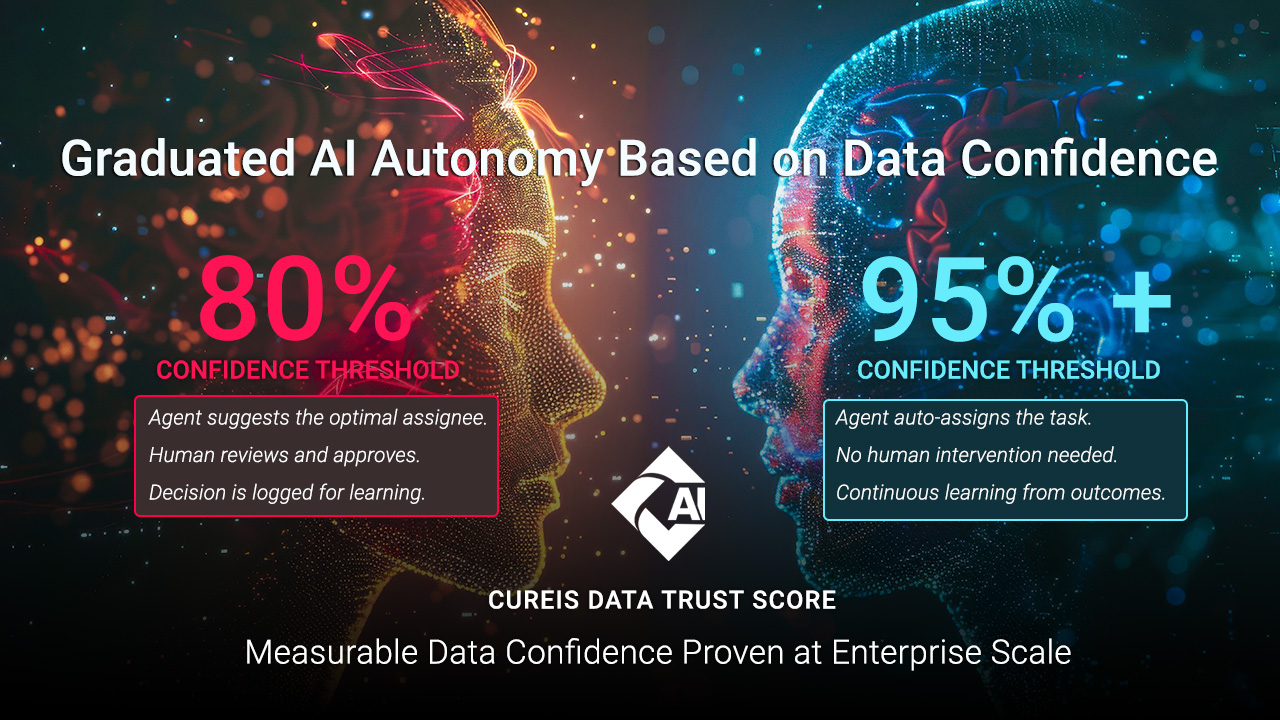
Many health systems are responding with kill switches, staged autonomy, and human-in-the-loop requirements at the agent layer. These are rational but blunt. A Data Trust Score moves precision to the data layer itself: to act autonomously on high-trust records, escalate degraded-trust ones intelligently, and explain exactly why. It makes existing guardrails smarter, not redundant.
From Concept to Architecture: Proven Today in UniSync™
The CureIS Data Trust Score is not a roadmap item or marketing concept. It is live inside UniSync™, our proprietary Health Data Management Platform, which has reconciled billions of transactions in complex government programs and managed care environments over the past decade. Where traditional DQ focuses on static rules, and academic indexes typically target research or narrowly scoped synthetic datasets, the Data Trust Score is dynamic, contextual, and production-proven, scoring live operational data – across ALL sources – at enterprise scale for real-time decision-making.
It rides directly on UniSync’s data foundation – a single conformed, governed source of truth with full bitemporal versioning and business-meaning reconciliation across members, providers, plans, authorizations, and payments. The score aggregates in real time using weighted, plan-specific logic. As new sources arrive or reconciliations complete, it updates automatically and travels as metadata with every record.
This enables CureIS AI agents to resolve enrollment and encounter discrepancies, manage retroactive impacts, and support revenue cycle and other high-volume workflows with measurable confidence, delivering auditable, defensible automation that regulators and boards will soon demand.
The Competitive Divide Ahead
The next three years will divide the industry into two camps.
One will deploy AI on conventionally governed data and spend their time managing exceptions, explaining errors, and rebuilding confidence after avoidable failures – essentially automating yesterday’s problems at tomorrow’s scale.
The other will equip autonomous agents with a native data trust signal. These organizations will achieve higher straight-through automation rates, lower exception volumes, fewer compliance surprises, and genuinely defensible decisions.
The Data Trust Score is how you reach the second camp. It is the missing layer between “our data is governed” and “our AI makes decisions we can stand behind.”
Healthcare no longer has a data-quality problem. It has a data-confidence problem. And confidence – unlike raw quality – is measurable, contextual, and actionable when your architecture is built for it.
Ready to move beyond governance into measurable data confidence?
UniSync™ turns fragmented healthcare data into a trustworthy foundation for bullet-proof compliance. Ensure your data is ready for whatever comes next. Deploy in weeks. No system overhaul needed. Schedule a free assessment to see how UniSync™ and the Data Trust Score can power confident AI decisions across your enterprise.
Frequently Asked Questions About the CureIS Data Trust Score
How does the CureIS Data Trust Score differ from traditional data quality scores or academic Data Trust Indexes? Traditional DQ focuses on static rules. Academic indexes typically target research or synthetic datasets. The CureIS Data Trust Score is dynamic, contextual, and production-proven, scoring live operational data at enterprise scale for real-time decision-making.
Is this only for AI? While agentic AI amplifies the need, every downstream process benefits: automation workflows, enterprise reporting, compliance audits, and especially retroactive change management.
How is the score computed inside UniSync? It aggregates multiple dimensions using weighted, business-specific rules. Scores update continuously and travel as metadata with every record.
What operational impact have clients seen? Sharply reduced exception volumes, faster cycle times, higher straight-through automation rates, and fewer compliance surprises – because systems act only when trust thresholds are met.
How does it help with regulatory compliance and audits? Embedded lineage, bitemporal history, and confidence signals create transparent, explainable data trails critical under evolving AI governance, HIPAA, and payment integrity rules.
How does the Data Trust Score relate to agent-level guardrails? It complements them. Kill switches and human-in-the-loop controls are blunt instruments. The Data Trust Score provides graduated, data-driven confidence, making guardrails smarter and enabling safer autonomy.
Related Posts
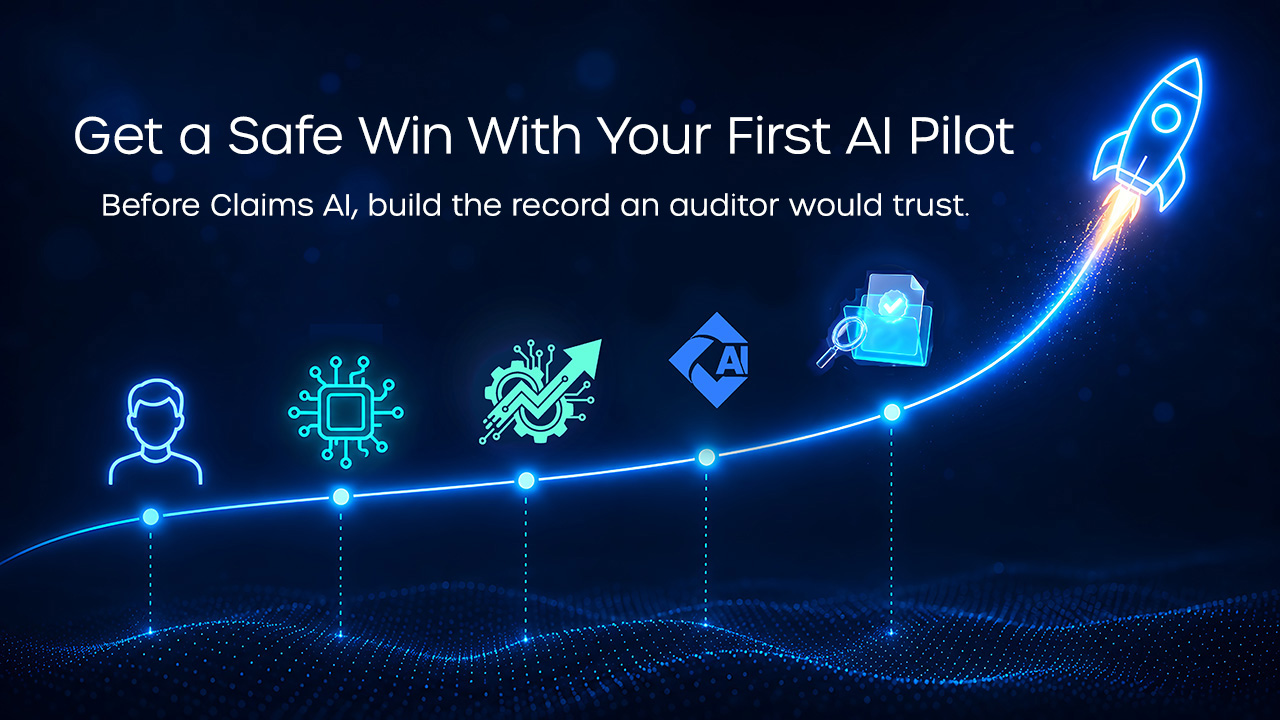
Before Claims AI, Build the Record an Auditor Would Trust In Brief: Mid-market...
An audit will require a record, not a reconstruction. In Brief: Arizona did...

In Brief: An auditor’s first question about a claims AI decision is usually: why...
