
Resources
Author

Encounter Management Case Study
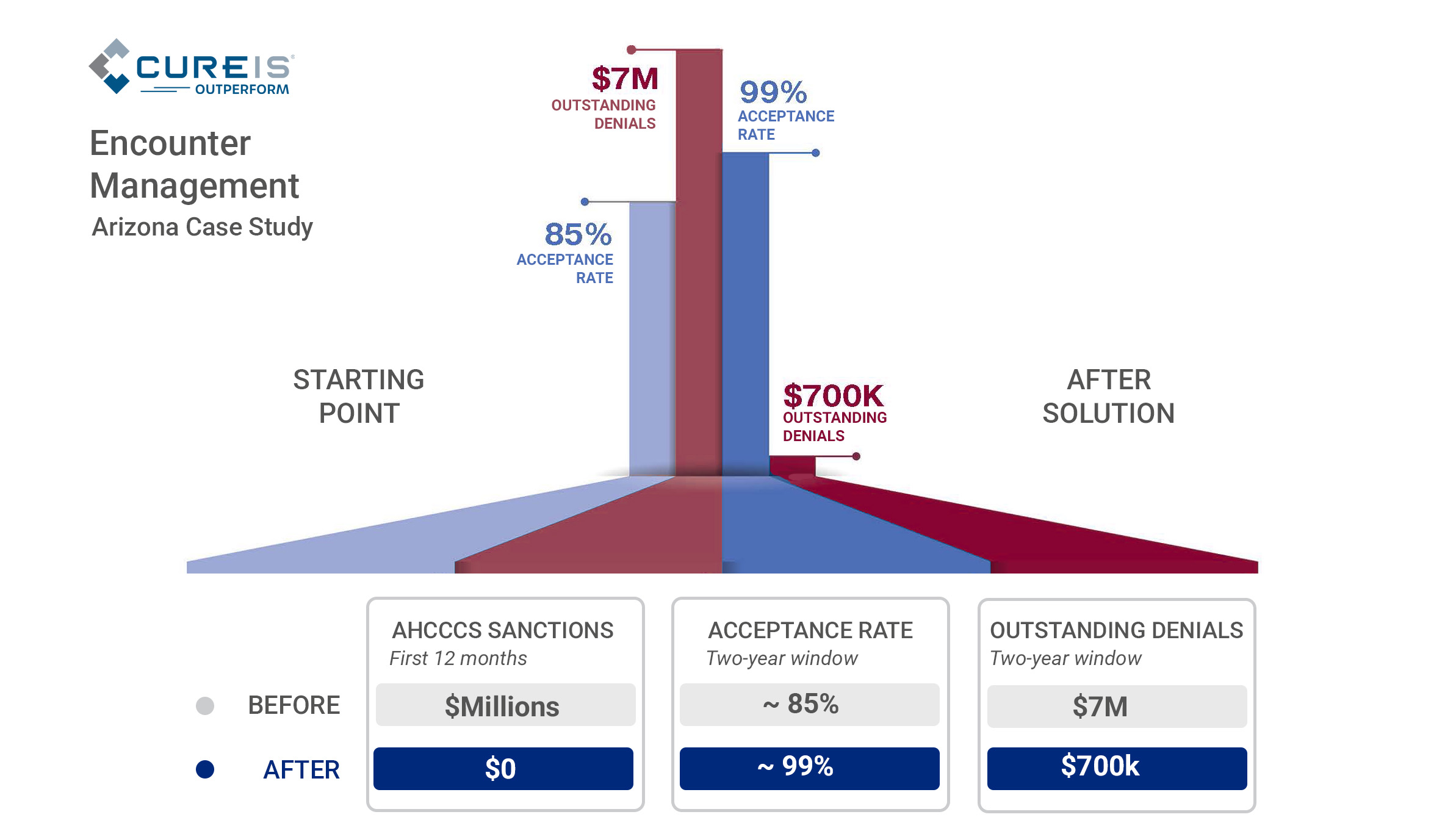
Arizona Medicaid Plan Reduced AHCCCS Sanctions from Millions to Zero in 12 Months.
An Arizona Medicaid plan reduced AHCCCS sanctions from millions of dollars to zero in just 12 months. During the same period, encounter acceptance improved from approximately 85% to nearly 99%, and outstanding denials dropped from $7 million to just over $700,000.
Background
Encounter data is the official record of a patient’s interaction with the healthcare system. It brings together key information from a medical claim, including patient and provider details, diagnosis codes, procedures performed, and associated cost elements.
For regulatory agencies to accept encounter data, it must meet a complex set of requirements. These rules evaluate multiple factors, including:
- Provider registration status.
- Whether the service is covered under the benefit plan.
- Proper handling of subsidies and cost sharing.
- Accurate adjudication and pricing.
- Alignment between the encounter and the original claim.
For Medicaid managed care plans, compensation depends on encounter files being accurate, compliant, and submitted on time.
In Arizona, the state does not simply reimburse a managed care plan based on the claim. The Arizona Health Care Cost Containment System, or AHCCCS, accepts or rejects the encounter. If the encounter is incomplete, inaccurate, or noncompliant, it can result in denials, reserves, sanctions, and lost revenue.
The Challenge
A leading Arizona Medicaid plan was managing its encounter process manually. The work required to meet AHCCCS standards had become unsustainable, both operationally and financially.
The plan identified two major challenges:
- Limited visibility into state-mandated government programs data
- No scalable process for reducing sanction costs
Manual encounter management made it difficult to identify errors before submission, reconcile encounters to claims, and respond quickly to rule changes. As a result, the plan faced significant financial exposure and operational strain.
The Solution
The plan overhauled its encounter operations using CureIS UniSync in combination with the EncounterCURE and ClaimsCURE solutions.
Together, these solutions created a more automated, transparent, and controlled process for managing encounter data. UniSync helped the plan perform the same validations AHCCCS would apply, but before the file was submitted.
The process included:
- Validating provider registration.
- Confirming benefit coverage.
- Reviewing subsidy and cost-share handling.
- Checking adjudication and pricing accuracy.
- Correcting incomplete or inconsistent records.
- Reconciling encounters back to the original claims.
- Incorporating rule changes directly into the workflow.
Instead of relying on spreadsheets and manual desktop procedures, the plan gained a repeatable process for identifying and correcting issues before they became denials or sanctions.
Results
Within the first 12 months, government-imposed sanctions were reduced from millions of dollars to $0. The plan also achieved major improvements in acceptance rates, denials, compliance, and operational efficiency.
Key results:
- AHCCCS sanctions reduced from millions to zero.
- Encounter acceptance improved from approximately 85% to nearly 99%.
- Outstanding denials reduced from $7 million to just over $700,000.
- Greater visibility into government programs data.
- Reduced encounter-related financial reserves.
- Improved compliance and operational performance.
With complete visibility into its government programs data and a more reliable encounter management process, the plan achieved substantial financial savings and stronger regulatory performance.
Client Quote
“Two years ago, during our cleanup push, we were around an 85% acceptance rate. Today, we are close to a 99% acceptance rate. Two years ago, we had $7 million in outstanding denials. Today, we have a little over $700,000 in denials. Our progress is amazing and something to be proud of.”
Conclusion
For Medicaid managed care plans, encounter accuracy cannot wait until after the state has the file. By that point, denials, sanctions, and reserves may already be in motion.
EncounterCURE helps plans reconcile encounter data to claims before submission, identify discrepancies earlier, and create a more controlled process for meeting state requirements.
For this Arizona Medicaid plan, that shift transformed encounter management from a manual, reactive process into a proactive compliance operation, reducing AHCCCS sanctions from millions to zero in 12 months.
Update: In 2026, the plan has reported two years completely sanction free.
Resources
AHCCCS “encounter denial” policy is outlined in several resources covering the rules, codes, and processes for identifying, resolving, and preventing denials of encounter claims:
The Fee‑for‑Service Provider Billing Manual and Fee-for-Service Claims Denial Edit Resolution Guide detail how encounters are processed, the codes and documentation required, and how denials are identified and resolved.
Related Posts
Identity tells you who the provider is. Evidence tells you whether the record is...

The Challenge Arizona and Hawaii Share: Medicaid Encounter Data in Capitated Managed Care If...
