Resources
![[Tori] Goldcast Insider Emailers](https://cureis.com/wp-content/uploads/2025/10/HR1_Resource-Center_Website_Column_Ad-1024x576.jpg)
Authors


Get a Safe Win With Your First AI Pilot
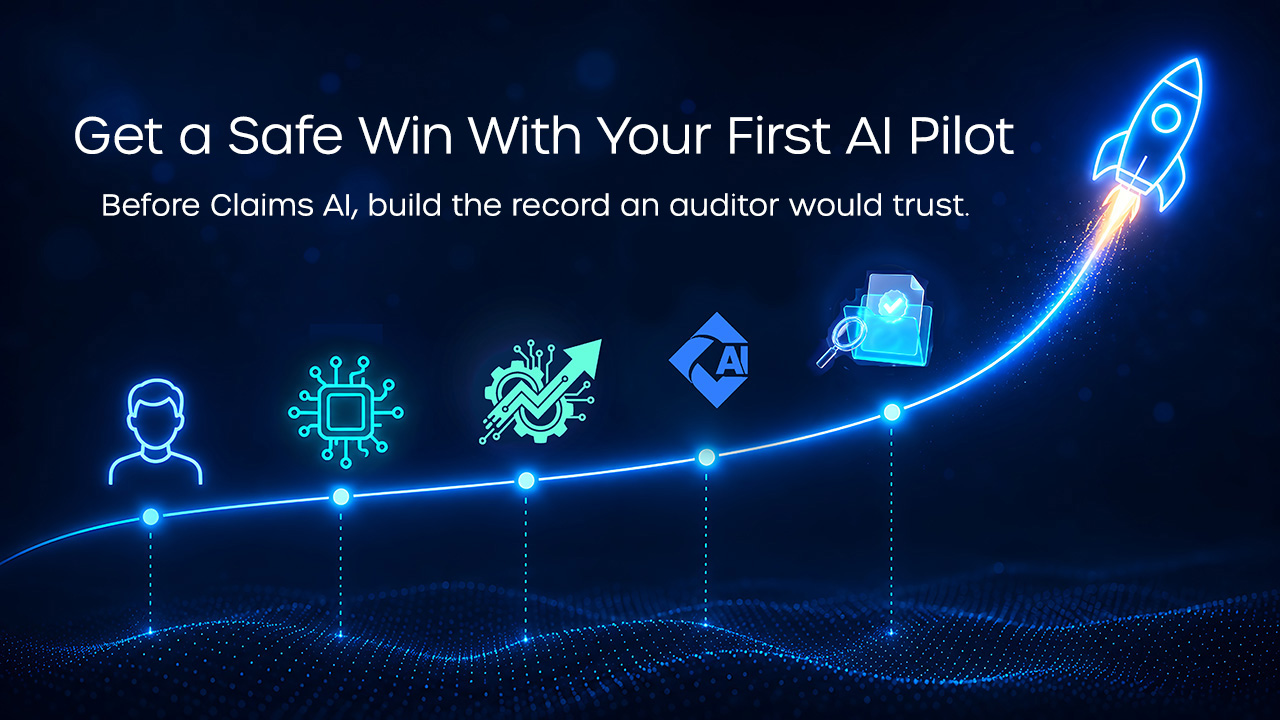
Before Claims AI, Build the Record an Auditor Would Trust
In Brief: Mid-market and community Medicaid plans are under pressure to “get started with AI.” Rather than developing an enterprise AI strategy, many simply need a first move. Claims operations present as the obvious use case: high-volume, expensive, and measurable. But this is also where the industry’s most visible AI failures are unfolding. Gartner has projected that through 2026, 60% of AI projects unsupported by AI-ready data will be shelved. AI doesn’t fix untrustworthy data; it accelerates the consequences.
A first pilot should be one tied to a problem that plans can measure, govern, defend, and build on. It should be owned by the plan and safe to get wrong. These parameters point toward a project that focuses on the ability to reconstruct, on demand, what the plan knew about a member, claim, provider, and eligibility span – and when it was known. That means conforming and reconciling data before automating on top of it.
Get this right and every later use case, including claims, becomes safe enough to automate. It’s the pilot that de-risks the rest.
The AI Question for Mid-market Plans
You’ve sat through the demos and the vendor pitches. The promises are familiar: lower cost, faster decisions, cleaner claims. The pressure to “get started with AI” has already pushed some plans into expensive pilots that went sideways, raising concerns about the next move. For a large national organization, a failed pilot is a line item. For a plan with limited resources, it’s staff time and budget they can’t spare.
In conversations with COOs and CFOs at mid-market, community, and Medicaid health plans, CureIS has encountered a recurring theme. Leaders believe AI could help, but the jury is out on where to begin and what a small, safe pilot even looks like.
For many plans, the safest first move is a bounded audit-readiness pilot: prove that the plan can reconstruct, on demand, what it knew about a member, eligibility span, provider, claim, and encounter – and when it was known. That capability de-risks claims automation, encounter improvement, redetermination workflows, and every later AI use case.
Why Claims Looks Like the Obvious Starting Point
For leaders considering a first pilot, claims AI seems like a no-brainer. The proposal practically writes itself. Claims operations are high-volume, rule-driven, and expensive. Denials, appeals, rework, provider abrasion, encounter rejects, eligibility mismatches, and retroactive changes all create measurable administrative drag.
On the appeals side, a team handling 200 denials a month can survive on spreadsheets and manual work queues. A team working 2,000 cannot. Deadlines slip. Easy claims get worked first, while high-dollar claims pile up. The backlog becomes permanent.
The numbers make the case seem even stronger. Recent industry reporting based on provider-side data puts average initial denial rates near 11.8%, with Medicaid denial rates reported at roughly 16.7%. The AMA estimates that reworking a denied claim can cost providers between $25 and $118. Plans carry their own administrative burden through rework, appeals, provider abrasion, encounter correction, and manual research. The burden is so high, many denials are never reworked at all, eventually becoming write-offs.
So yes, claims is a fire. It can also be a consequential mistake as a first AI pilot.
The Big AI Risk is Automating on a Record You Cannot Defend
Claims AI is where “getting it wrong” happens at machine scale and where the downstream cost includes regulatory scrutiny, provider abrasion, and reputation damage. In particular, automating claims decisions before the underlying record is defensible can turn an operational challenge into a compliance, dispute, and trust issue. Lackluster ROI is the least of your problems if a regulator, state, or auditor exposes a weakness in your new AI initiative. When a decision comes under scrutiny, plans must prove what the system knew, when it knew it, and why it acted.
The industry has already seen the media fallout and regulatory scrutiny that follows when coverage and care decisions are automated on data and rules a plan cannot fully explain. That’s the reason many mid-market and community plans have paused their AI roadmaps. Standing still has a cost too. A more risk-averse response is not a bigger strategy. It is understanding why these systems fail once they leave the demo.
Most failures happen when AI meets real operational data, which is inconsistent, incomplete, duplicated, and spread across systems that disagree. Member data doesn’t match eligibility. Eligibility on the date of service doesn’t match what the claim assumed. A retroactive update lands after the claim is paid.
AI doesn’t fix any of that. It inherits and amplifies the quality of your underlying data, good or bad.
Before a plan automates claims decisions, it needs a trustworthy record of what happened.
Claims automation on untrustworthy data is high risk. Your first move is to find out what your data would say to an auditor, a state reviewer, or a model – before someone else does.
— Chris Sawotin, CEO, CureIS Healthcare
That reconstructable record allows a plan to defend decisions swiftly and accurately. At CureIS, we sometimes call this “audit insurance.” More plainly, it is audit defensibility: the operational ability to prove what the plan knew, when it knew it, where the data came from, and what action followed.
What “Audit Insurance” Means
Audit insurance/defensibility isn’t a financial instrument or product category. It’s an operational capability: the ability to prove, on demand, what the plan knew and when. For a given member, claim, or encounter, it means showing who the member was; what eligibility information was available on the date of service; what the claim assumed when it adjudicated; what provider data was used; whether a retroactive change occurred, and when; whether the encounter passed state and T-MSIS checks; and what action was taken, by whom, and on which record.
For Medicaid plans, that capability is becoming critical as data scrutiny intensifies. CMS resumed T-MSIS data-quality compliance actions in September 2025. The immediate accountability sits with states, but the operational pressure flows to managed care plans through encounter-data requirements, corrective-action requests, contract findings, sanctions, and short timelines to produce evidence.
The scenario is familiar: a state or auditor asks for evidence, and you have thirty days to show that eligibility on the date of service matched the claim you paid, that the encounter survived the state’s checks, and that any retroactive update was reprocessed against the right record.
The data exists somewhere. The question is whether your team can reconstruct it quickly, consistently, and defensibly – or only through heroic manual effort. That’s a fire worth starting with.
A Simple Test for Your First AI Use Case
Analyze candidate pilot on five questions. A strong first move is on fire in the next two cycles, measurable with data you already produce, bounded if it goes wrong, owned by the plan end to end, and built on data you can actually reconcile. Score the three use cases most plans are weighing and the picture clarifies fast.
| Question | Claims Denials Engine | Redetermination Retention | Audit/CAP Evidence |
|---|---|---|---|
| 1. Is it on fire in the next two cycles? | Yes: volume, write-offs, rework. | Rising: 2027 expansion cycle. | Yes: T-MSIS enforcement, state sanctions, CAP exposure. |
| 2. Can we measure it with data we already produce? | Yes: CARCs, overturn rates, rework. | Partly: depends on clean eligibility spans. | Yes: reject codes, DQ flags, time-to-evidence. |
| 3. Is the cost of being wrong bounded? | No: coverage decisions and litigation risk. | Medium: member loss, revenue, state dependency. | Largely, yes: the pilot focuses on evidence, reconciliation, and response workflows before automating consequential decisions. |
| 4. Do we own the workflow end to end? | Partly: shared with providers, policy, rules. | Partly: shared with the state. | Largely yes: evidence assembly and reconciliation are plan-owned. |
| 5. Is the data underneath reconcilable? | Often not yet. | Often not yet, especially with retro spans. | Must be: which is why it’s the starting point. |
Claims loses on the most important question: the cost-of-being-wrong. The risk is highest when AI is making or materially driving consequential decisions, not when it is summarizing, triaging, or surfacing evidence for humans.
Redetermination retention is important, especially as plans prepare for more frequent Medicaid eligibility checks for affected expansion populations in the 2027 cycle, subject to state implementation and CMS guidance.
Audit and CAP readiness wins because it’s urgent, measurable, bounded, plan-owned, and foundational. And it funds the next use case. Once a plan can reconstruct and trust the record, claims automation, redetermination workflows, and encounter improvement become safer to pursue.
SIDEBAR
The Unintended Bonus: AI Discipline
Audit defensibility protects the plan when a dispute, unexplained denial, state audit, or CAP request lands. It also builds the exact discipline AI demands. To defend a determination, the plan has to show where the decision came from, what data supported it, how far that data could be trusted, and what changed afterward. Every AI-assisted decision requires the same habits.
“The muscle memory of evidentiary backing – where a decision came from, what data supported it, and how far you could trust it – is exactly the skill set a successful AI capability is built on. And there’s no cheap shortcut to it.” — Bret Randolph, CureIS COO
Why the Weekend Prototype Fails in Production
The do-it-yourself path is getting a serious hearing, especially from organizations with strong internal IT teams. It’s not surprising. Today’s tools make prototyping look easy. A couple of sharp developers with a cloud credit and a clean data set can produce an impressive audit packet or claims summary in a weekend.
The demo works fine. Production is where it breaks. The real operating environment is a labyrinth of source systems, manual adjustments, delayed feeds, retroactive changes, duplicate records, and business rules that live in people’s heads.
A weekend prototype answers the easy question: can we generate something useful from clean data? A production pilot has to answer the hard one: can we generate something accurate, repeatable, traceable, and defensible from the data we actually run on?
Those are different problems, which is why so many pilots stall after the demo. Nothing is wrong with the design. Things go south when they meet an ungoverned record at scale in a data foundation that wasn’t ready for automation.
A successful first AI move has to survive the real world: production data, operational exceptions, compliance scrutiny, and the moment when someone asks, “Show me how you got that answer.” Internal teams absolutely have a role to play. The question is whether they are being asked to build an AI feature before the organization has built the governed data layer that feature depends on.
The First Move is the Record
If your plan is eyeing AI for claims, appeals, redeterminations, or encounters, the first move isn’t buying a denials engine or standing up a chatbot. It’s making the underlying record honest. That means creating one governed, reconcilable view across the transaction path:
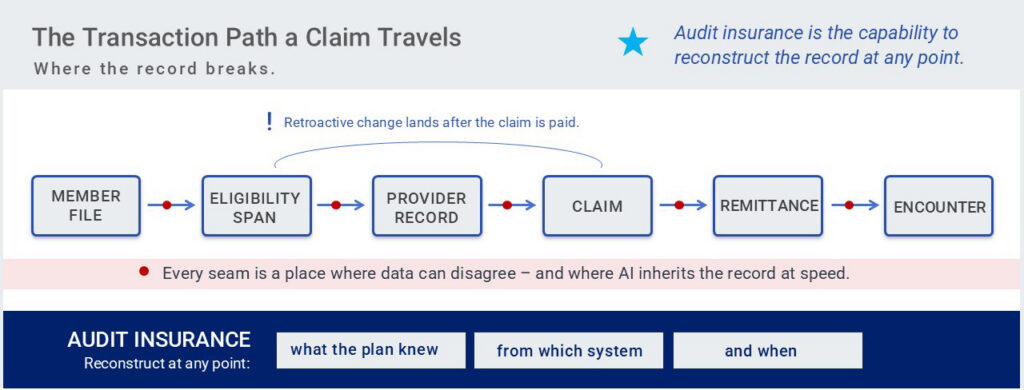
Not that every plan has the same transaction path, but every seam is a place where the record can diverge. An overnight feed. A manual match. A retroactive change that lands after a claim is paid. In production, the record may also depend on benefit configuration, provider contracts, fee schedules, authorization data, COB/TPL, state edits, and manual overrides.
Audit insurance means that at any of those points you can reconstruct what you knew, from which system, and when. Until those questions can be answered consistently, AI is running on an unstable foundation.
You don’t need a transformation program to get started. The first pilot should be narrow, measurable, and focused on conformance, reconciliation, and lineage.
A Data-First Path to a Safe AI Pilot
Before choosing an AI tool, choose the workflow and the record it depends on.
- Name the workflow, not the technology. “Use GenAI in claims” isn’t a pilot. “Cut eligibility-related claim rework by half before the next six-month cycle” is closer. “Reduce time-to-evidence for encounter audits from ten days to two” is better yet: specific, measurable, tied to a real deadline.
- Trace one transaction end to end. Follow a single claim or encounter along the path in the diagram (above) and circle every handoff that is batch, manual, overnight, or reconciled after the fact. That map is your first readiness assessment.
- Trust-score the seams. Using a recent 90-day population, ask how often eligibility on the date of service disagreed with the claim, how often retroactive changes landed after payment, how often encounters failed for knowable reasons, and how much manual effort reconstruction took. That’s your baseline.
- Fix conformance and lineage before the model. The goal is not necessarily a new golden-record program or core migration. The goal is a governed, point-in-time, reconcilable view of the transaction record, with lineage.
- Only then add narrow, human-in-command assistance: meaning once the record is trustworthy, AI can assemble, summarize, flag, and route information, but a qualified human makes consequential decisions that affect coverage, payment, or care. That mirrors how many plans and state Medicaid agencies are approaching AI governance.
The Takeaway
Your first AI pilot should be the one that de-risks every future initiative in your roadmap. For mid-market and community Medicaid plans, audit defensibility offers a practical, bounded first win. It may not electrify the C-suite like an autonomous claims engine, but it creates the foundation that determines whether future automation is accurate, measurable, and defensible.
The plans now defending automated decisions didn’t set out to build high-risk AI. The lesson learned is that hidden data and governance weaknesses are a ticking time bomb that must be fixed before, not after, an AI pilot reaches production.
A good first move means making your data trustworthy enough to build on, then shipping one measurable pilot your operations can own. That beats an impressive AI strategy deck you never execute, and it beats a weekend prototype that can’t produce receipts when an auditor says, “Show me the record.”
About CureIS and UniSync
CureIS (est.2006) is the standard for trusted healthcare data. We’ve spent two decades inside managed care data and claims operations. We build on that foundation, challenge how things have always been done, and modernize health plan operations without a rip-and-replace. Audit-ready operations follow from that approach.
UniSync is a conformance-and-reconciliation layer for managed care operations. Battle-tested at scale in complex enterprise environments, UniSync conforms, reconciles, and trust-scores operational data across the systems a plan already runs. It operates alongside production environments without a core migration and gives the plan a defensible, point-in-time record to support audit response, encounter improvement, eligibility reconciliation, claims operations, and future AI-enabled workflows.
Join us for the upcoming webinar, Getting Started With AI, for mid-market and community health plans that need a practical first move.
Frequently Asked Questions
Where should a mid-market plan start with AI?
Start with a bounded workflow that improves the trustworthiness and defensibility of the operational record. For many Medicaid plans, that means audit/CAP evidence readiness: the ability to reconstruct what the plan knew about a member, eligibility span, provider, claim, or encounter; when it knew it; and which system the information came from.
Isn’t claims the bigger dollar problem?
Usually, it is. But it comes with a lot of baggage. Claims automation is risky if the underlying record is inconsistent, incomplete, or difficult to reconstruct. By fixing the data foundation first, plans make later claims automation safer, more measurable, and more defensible.
Why is automating claims risky?
The risk is not automation itself. The risk is using automation to influence or make consequential payment, coverage, or appeal decisions on data and logic the plan cannot explain, reconstruct, or defend.
We have developers. Why not build our own AI tools?
Internal teams can build useful prototypes quickly. Production is harder. Managed care data is spread across systems that often disagree, and the record changes through delayed feeds, manual adjustments, and retroactive updates. Unless the data is conformed, reconciled, governed, and traceable, an internal tool can perform well on curated data and still fail under operational or audit pressure.
Why are so many healthcare AI projects failing?
Many AI projects fail because the data underneath them is not ready for automation. Models can perform well on clean samples and break when they encounter inconsistent member, eligibility, provider, claim, and encounter data. The fix is to conform, reconcile, and govern the data before relying on AI-enabled workflows.
Does CureIS UniSync replace our compliance vendor, warehouse, or SIEM?
No. UniSync runs alongside existing systems. Its role is to conform, reconcile, and trust-score operational data so member, eligibility, provider, claim, and encounter records line up at the transaction level, with lineage.
Does OBBBA change where plans should focus first?
It raises the stakes. More frequent Medicaid redeterminations for affected populations could put retained members and revenue at risk, depending on state implementation and CMS guidance. But neither claims automation nor eligibility outreach is safe to scale unless the underlying record can be reconstructed quickly and accurately.
Sources
American Medical Association. Estimates of the administrative cost to rework a denied claim ($25–$118).
Centers for Medicare & Medicaid Services. State Health Official letter on T-MSIS data-reporting compliance, May 28, 2025. Data-quality compliance actions resumed September 1, 2025; repeated monthly misses can trigger a corrective action plan requested within 30 days. T-MSIS file-layout version 4 expected in production by September 30, 2026.
CMS. Guidance on Medicaid six-month eligibility redeterminations under the One Big Beautiful Bill Act, 2026.
Gartner. “Lack of AI-Ready Data Puts AI Projects at Risk.” February 2025. (Prediction: through 2026, organizations will abandon 60% of AI projects unsupported by AI-ready data.)
Health Affairs Forefront. “How States Can Improve Medicaid Encounter Data.” April 2026.
Qualigenix. “Medical Claim Denials 2026: Types, Rates & Appeals.” 2026. (Initial denial rates by payer, including Medicaid; citing OS Healthcare and Experian Health data.)
KFF. Medicaid program-integrity tracker and Managed Care Program Annual Report (MCPAR) reporting on state sanctions, including corrective action plans.
Medicaid.gov. Transformed Medicaid Statistical Information System (T-MSIS) Outcomes-Based Assessment methodology and state data-quality progress.
MedCity News. “The AI Playbook for Health Plans: 5 Steps for Leaders Who Don’t Know Where to Start.” July 2026. (Comparable market piece.)
Urban Institute. “Projected Reductions in Medicaid Expansion Enrollment Under OBBBA’s Work Requirements and Six-Month Redeterminations.” April 2026.
Related Posts
ROPA is a provider enrollment rule that turns into a health plan data problem....
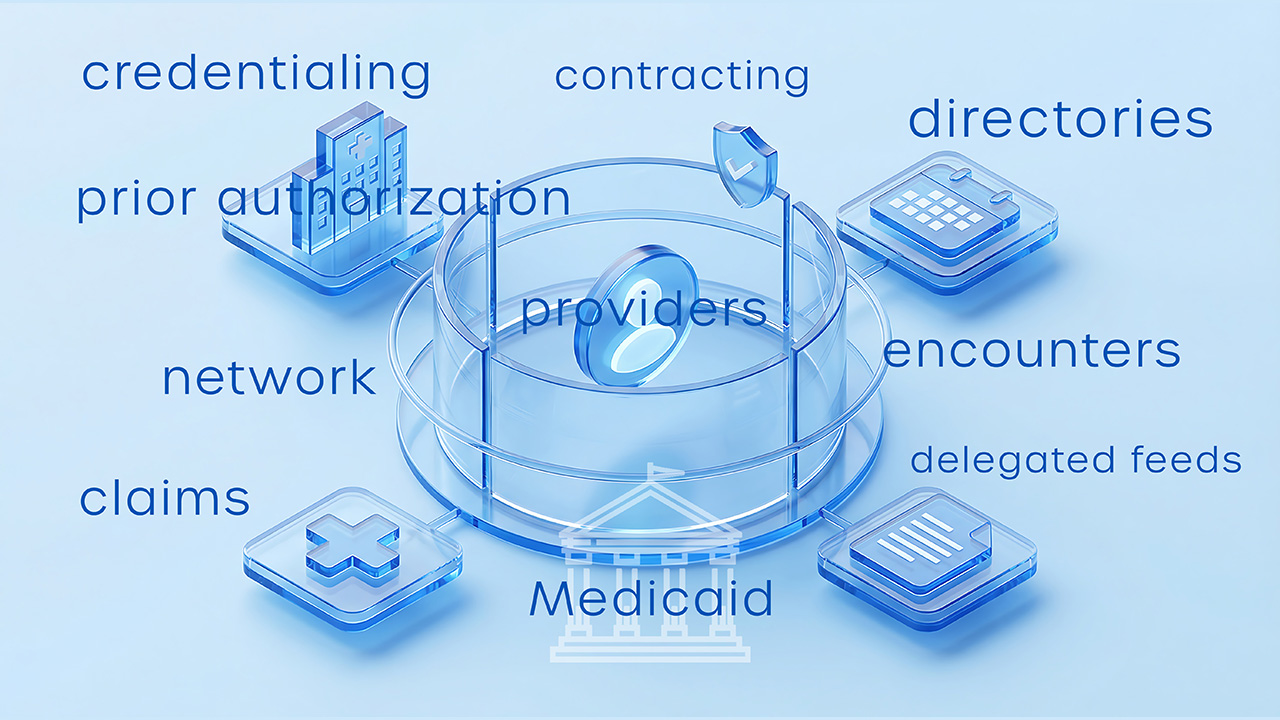
Identity tells you who the provider is. Evidence tells you whether the record is...
An audit will require a record, not a reconstruction. In Brief: Arizona did...
